I was Given 72 hours to Leave Pakistan: A High Commissioner’s Story
August 2019 brought one of the sharpest disruptions in India-Pakistan relations as India revoked Article 370, which had granted special status to Jammu and Kashmir. The move rattled Islamabad, sparking hurried diplomacy and an atmosphere thick with speculation. Here, Ajay Bisaria, then India’s High Commissioner to Pakistan, recounts the emotional weight and professional turbulence of navigating an abrupt exit from one of the world’s most fraught diplomatic frontlines.
I was expelled from Pakistan in 2019.
I had been stationed in Islamabad as India’s high commissioner (HC) for twenty months at that time. It was August, the month that cools Islamabad, when evenings turn pleasant, leaves turn golden to drift aimlessly on sidewalks. To the city’s many expats, it feels more like early fall in Europe than late summer in Asia.
My Departure from Pakistan in AUgust 2019 was rather sudden.
A gorgeous orange sun dipped into the horizon as I gazed out of the window of the armoured black BMW driving me to the Islamabad International Airport, a hurriedly inaugurated new facility, still leaking from recent rains. I felt short-changed by my unusual diplomatic departure. No fancy farewell reception preceded it, no series of dinners with special Balochi meats and Punjabi hospitality, no goodbye speeches, no jhappi-pappis, no media interviews to summarize my tenure, no witty recalls of my adventures in Islamabad mansions, not even a hurried shopping trip to Jinnah Super for mementos. I had a gnawing sense of leaving behind an unfinished agenda, something I had forgotten to do but could not quite recall what. It felt more interruption than closure.
I boarded a flight to Abu Dhabi on that breezy, almost-autumn evening, after the unannounced drive on the Srinagar Highway. I wondered if I would ever return, as I tried to process the events of the past week that had altered my neat plans for the month and jolted the already troubled ties between South Asia’s sibling nations.
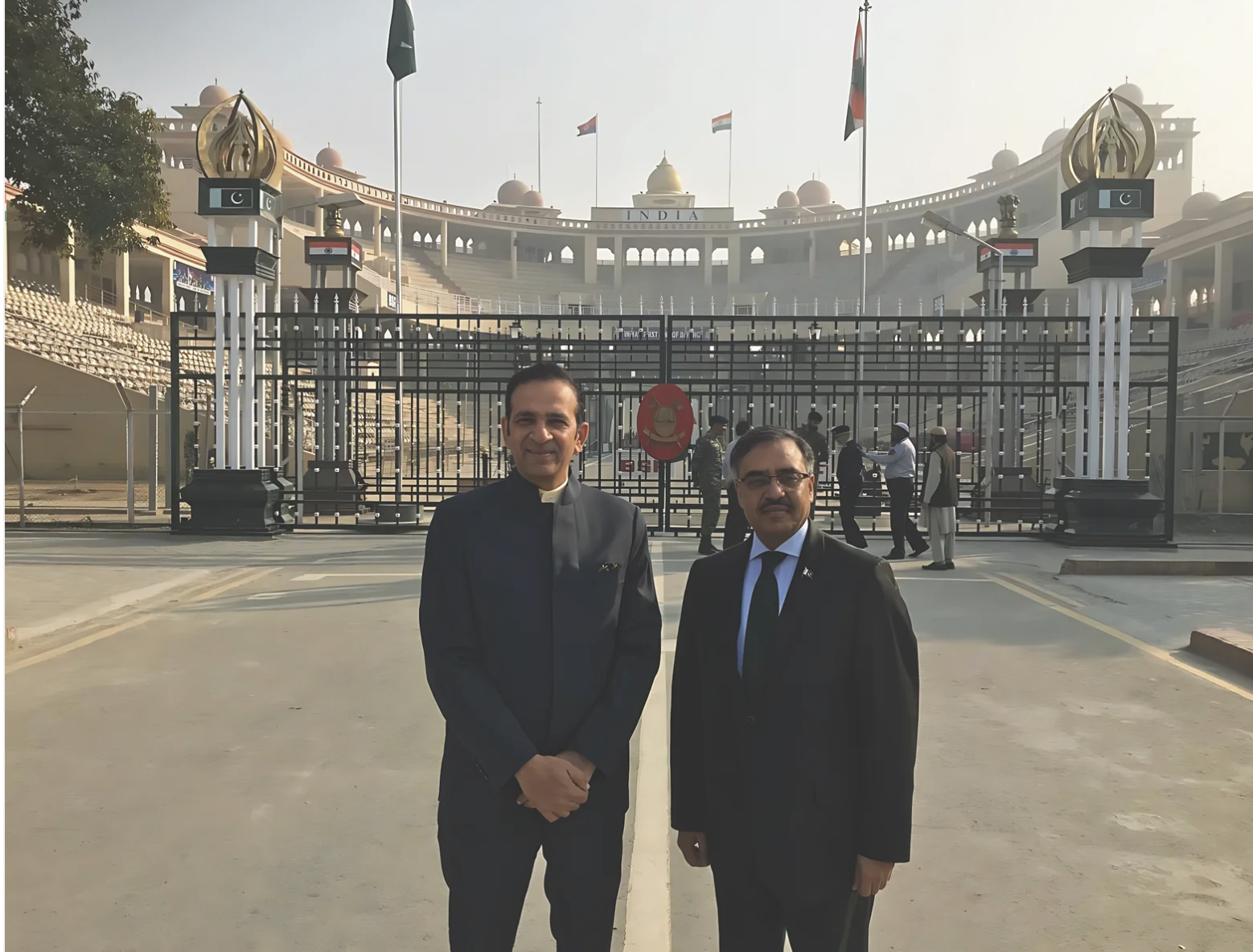
Even as I quietly boarded the Etihad flight to Abu Dhabi, media vigils awaited me at Wagah and at Attari, on both sides of the Punjab land—crossing between the two distrustful neighbours. My impending departure had become a subject of shrill speculation over the previous three days, from the moment my marching orders became public. Electronic media channels on both sides of the border had cameras trained on the crossing’s large clanging iron gates, expecting me to arrive by road at Wagah, cross over to Amritsar, and catch the evening flight to Delhi. We had led them on; a dummy booking in my name was in place on Air India since the previous day. The channels were playing up each micro-step of my exit; the tickers were breathlessly breaking the news, ‘Expelled Indian HC on way to Wagah’.
I disappointed them both with an unglamorous aerial exit.
I left Islamabad with mixed feelings—much lightness and some regret. I was relieved to exit the surreal bouts of hostility that marked my professional life, but missed being in the thick of the hard talk, missed being able to bid farewell to many personal friends and diplomatic colleagues.
Meeting in the Corner
Five days earlier, as shrill birdsong pierced the dawn on 5 August, hours before India’s parliament dismantled Article 370, I had walked briskly in the little lawn within India House in the tony F6 sector of the geometrical cityscape of Islamabad—a town created in the 1960s, modelled after the ancient city of Taxila next door—with the foreboding that something dramatic would happen. Yet, I had nary a suspicion that rapidly unfolding events in the next few hours would precipitate my exit from the country within the week.
In conversations days earlier, some Western diplomats had alerted me that Pakistan’s leadership was repeatedly and nervously summoning them, complaining of India’s military build-up in Kashmir. The American envoy had suggested to the foreign office mandarins that Pakistan should convey its strong feelings directly to the Indian high commissioner.
And so, at 6 p.m. on 5 August, I was summoned to Pakistan’s Foreign Office. I had conferred with India’s foreign secretary, Vijay Gokhale, before the meeting, since it was plain what my hosts would say. I was to meet my primary interlocutor, Foreign Secretary Sohail Mahmood, with whom I had struck up a comfortable working relationship; we were on first name terms. We had candidly discussed some difficult issues in the past: during my visits to India when he was Pakistan’s high commissioner in New Delhi and also in Islamabad over his past few months as the foreign secretary, where we had together untied some knots. But this was different. It was serious.
As I was led into the plush corner room, defined by its oversized bottle-green chesterfield chairs, I quipped to lighten the mood, ‘Looks like we’ve kept you busy.’ Mahmood nodded unsmilingly, ‘I wish you hadn’t.’ We shook hands. I hoped to keep the tone friendly; we were, after all, professionals doing a job. ‘High Commissioner, we have a statement from the highest levels of our government, which I will read out,’ he began stiffly. This was clearly not the day for first names. He droned gently through strong words of outrage at India’s decision, a prepared script that I assumed would be out in the media minutes after I left his office.
That statement was to become the party line that would in subsequent days be repeated as Pakistan’s official narrative at every conceivable forum and would soon be embellished with harsher, more abusive words. I was wondering what exclusive message would be delivered for India in this special démarche I was summoned for. I nodded at the young second secretary, Vipul Dev, who accompanied me to this tryst. He took furious notes. These were not really necessary, given that the text of Pakistan’s outrage was soon made available to the world:
The Foreign Secretary summoned the Indian High Commissioner to the Foreign Office and conveyed a strong demarche on the announcements made and actions taken by the Government of India with regard to Indian Occupied Jammu and Kashmir today.
The Foreign Secretary conveyed Pakistan’s unequivocal rejection of these illegal actions as they are in breach of international law and several UN Security Council resolutions. Pakistan’s resolute condemnation of the unlawful actions aimed at further consolidating the illegal occupation of Indian Occupied Jammu and Kashmir (IOK) was underscored….
The Foreign Secretary called upon India to halt and reverse its unlawful and destabilizing actions, ensure full compliance with UN Security Council resolutions, and refrain from any further action that could entail serious implications.
The Foreign Secretary reiterated that Pakistan will continue to extend political, diplomatic and moral support to the indigenous legitimate Kashmiri people’s struggle for realization of their inalienable right to self-determination.
This level of rhetoric was pretty much par for the course for India–Pakistan squabbles. But this time, it was only the take-off point for more to come. After the foreign secretary had sombrely delivered this tough message in his elegant corner room, I said I had a few points to make. This seemed to puzzle my host. A démarche by the foreign office of Pakistan to an Indian diplomat, howsoever harsh, normally meant you hear out a tirade, mostly delivered politely, say you’ll pass it on back home, exchange pleasantries on some unconnected subjects, shake hands and leave. The script that evening was altered.
I said that while I would, of course, pass on the contents of Pakistan’s statement to my government, I was under instructions to reject this take on events and in turn explain India’s position to Pakistan. What had transpired in our parliament was an internal matter for us—India had made amendments to its Constitution through due process in its legislature, and we believed Pakistan had no locus standi in this matter. We presumed Pakistan had read India’s Constitution, particularly Article 370, which was a temporary and transitional provision which India’s government and legislature was entitled to change. Due procedure had been followed in broad daylight after a nationally televised debate. This issue did not change the status quo on the border; the sanctity of the Line of Control (LoC) had not been disturbed in any way. Besides, one of the factors that had complicated the Jammu and Kashmir situation for India was Pakistan’s export of terrorism across the border for over three decades. The last bit was not strictly part of the script for the occasion, but I had improvised the talking point, to offer a more rounded appreciation of India’s take on events.
The foreign secretary, while not surprised by the thrust of my argument, did appear taken aback by this kind of pushback. He was not about to give me the last word. He countered that Pakistan completely rejected India’s posture and went on to explain how cross-border events had nothing to do with India’s ‘siege’ of Kashmir.
I walked out after a grim handshake. The TV channels were breaking the story on Pakistan’s démarche even before I ended my five-minute drive from the imposing Ministry of Foreign Affairs (MOFA) building in Islamabad’s red zone to the Indian high commission in the adjoining diplomatic enclave. After some consultations with Delhi, we decided not to publicly share our version of my posture at the meeting that day. In any case, Pakistan’s démarche did not get much play in the Indian media. Far too much was going on within the country.
On 7 August, the official outrage crystallized further. In a special session of Pakistan’s parliament, the mood was of high indignation, often masking high panic; the decibel levels were matching the anger. Pakistan’s leadership was floundering for the right response. Foreign Minister Shah Mahmood Qureshi fulminating in parliament and in media interviews against India’s agenda to ‘bury the issue of Kashmir’, warned that diplomatic ties were under stress and hinted that the Indian high commissioner might be asked to leave.
At the high commission, we went on high alert. I asked all diplomats to stay back in the chancery and work on all contingency options. Pakistan could choose from a menu of angry expressions—snapping diplomatic ties, closing down the mission, reducing the strength of diplomats by half or just expelling the Indian high commissioner. We could all be leaving our station in the next days or even hours. Would we need to kick in war protocols like the destruction of records? Would we need to leave in a convoy of cars for Amritsar the next day?
In the event, Pakistan decided to exercise the least disruptive choice. I was given seventy-two hours to leave the country.
The director general for South Asia, Mohammad Faisal, called in Second Secretary Akhilesh Singh, whom we had hurriedly designated the acting deputy high commissioner—since the regular deputy, Gaurav Ahluwalia, was away in India—and passed on Pakistan’s ‘request’ for India to withdraw its high commissioner.
Two days later, I was headed home.
In the turbulent days leading up to my departure, even as I assured family back home that I was in no physical danger, I sent reports and assessments to headquarters on the evolving situation. I called up two of my predecessors, to get the context straight in my head. The first was T. C. A. Raghavan, my go-to colleague, a historian, and a veritable encyclopedia on the relationship, who had handled Pakistan multiple times in his career and written extensively on it. He said he had hoped it would not come to this, but told me reassuringly that I would still continue to be the high commissioner to Pakistan, but based in India ‘on temporary duty’.
I then rang up Vijay Nambiar, who had faced a similar fate two decades ago. I wanted to get some insights from the turn of the century. He told me cheerily that he had not been removed at Pakistan’s instance, but withdrawn by India, as a reaction to the terror attack on India’s parliament in 2001. He had even played some golf before his departure. Now that was a thought. I could follow this precedent and exit on a swinging note with a farewell round at the Islamabad Golf Course. But I decided against this given the workload prior to departure.
Awkward Grace
With the clock ticking, the packing itself became an oddly reflective exercise. I was torn between wrapping up at the office and at home, and decided to focus on the former. At home, I asked my staff to keep one suitcase ready for a trip
to Delhi. My two housekeepers, Ravi and Satish, watched me with a mix of concern and gentle reproach, as though my sudden exit was somehow a personal failing. I reassured them that they would not be left adrift, even as I weighed the practicalities of what could be carried immediately and dispatched later.
A few Pakistani friends called or texted in those final hours-some out of genuine concern, others perhaps out of polite instinct to reach out when diplomacy sours. Their messages were brief but heartfelt, lightly wrapped in the formal phrasing that often stands in for emotion in our profession. Many said simply, “You will be missed in Islamabad,” which, in a relationship as fraught as ours, felt like a small triumph.
Personally, I found the experience curiously steadying. I discovered that the practicalities of leaving-sorting papers, emptying cupboards, deciding what to keep and what to leave behind —leave little room for melodrama. There is something grounding about shredding paper while history rages outside your window.
Then came the unexpected twist: Bharatis proposed arrival. When we gingerly conveyed to the Foreign Office that my wife might return to wrap up the household after my departure, I expected a swift refusal. Their eventual assent-couched in a request for discretion —felt almost generous. They reminded us that they were familiar with her social media presence and cautioned that her stay should avoid public visibility. Our deputy HC, Gaurav Ahluwalia, dutifully assured his MFA interlocutors that she would be on good behaviour and focus entirely on packing.
Bharati crossed at Wagah soon after I left, determined not to miss out on the endgame excitement of my posting and eager to tidy up the loose ends of our life in Islamabad. But word travels fast in that city, and before long, the media had begun reporting her presence. It made for an odd coda: I had slipped out quietly by air, while my wife’s perfectly mundane mission of wrapping up became the subject of headlines: Ajay Bisaria’s wife arrives in Islamabad to pack up-departure certain! In between sorting books and supervising packers, she met a few friends who insisted on bidding her proper farewells-small, warm gatherings that partly compensated for my being denied that courtesy. Through her social whirl, the High Commission was officially asked more than once by the Foreign Office when this prolonged packing mission would end.
By the time she concluded her week-long visit, the house was partially packed and the domestic staff primed to follow her in a couple of days via Amritsar, soon after they had been hosted for a farewell bash by the security staff. The chapter seemed— if not closed—tidied in its own way. And as Bharati quietly crossed the border, I found myself thinking that perhaps this was the way Indo-Pak stories sometimes end: not with grand gestures, or as major tragedies, but often with small, unplanned moments of awkward grace.
XXX
This is a Memoir of Ambassador Ajay Bisaria from his book “Anger Management” Published in India’s World.