Trump❤️Munir: Why & What It Means
When Gen Asim Munir landed in Tehran on Wednesday, armed with an American truce offer, he was following up on the weekend’s 21 hours of direct US-Iran negotiations, held in Islamabad – the most substantive bilateral engagement between Washington and Tehran, since the severing of diplomatic relations, in 1979. That Pakistan provided both a venue and diplomatic channel for […]
BBC: Pakistan’s push in Iran war diplomacy – is India sidelined?
The chatter in Delhi is unmistakable: as Pakistan positions itself as an intermediary in the US-Iran crisis, is India being sidelined? Islamabad has moved with unusual agility, casting itself as an intermediary between Washington and Tehran. Last week, it reportedly relayed a 15-point US peace plan to Iran and offered to host talks – an […]
I was Given 72 hours to Leave Pakistan: A High Commissioner’s Story
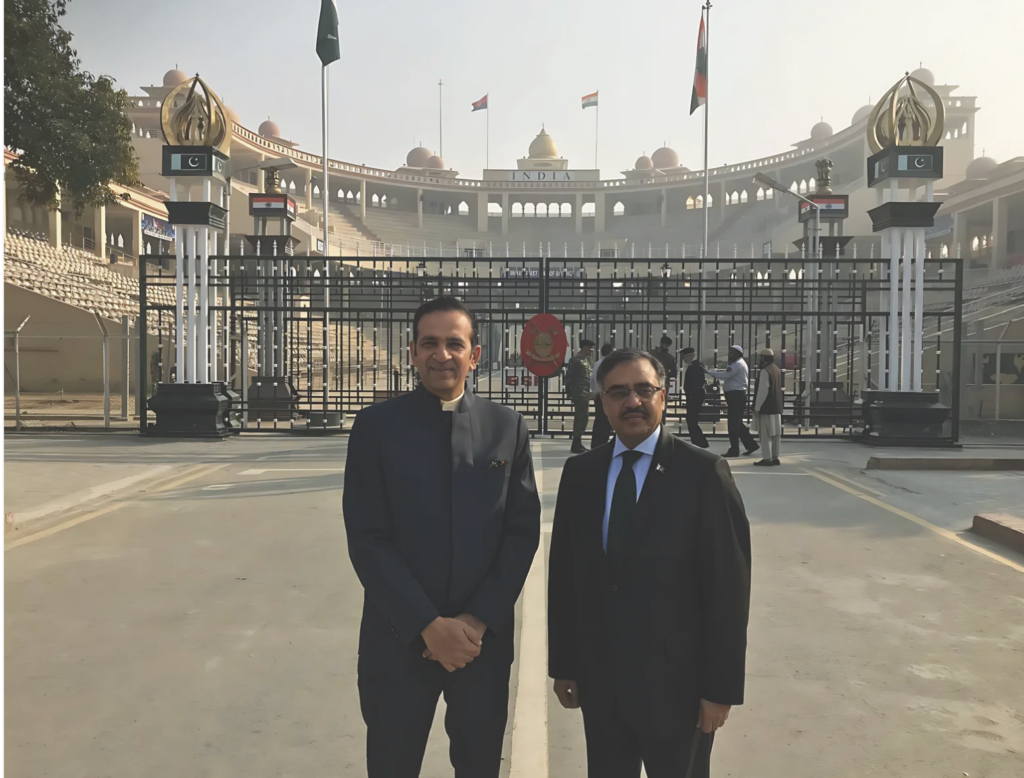
August 2019 brought one of the sharpest disruptions in India-Pakistan relations as India revoked Article 370, which had granted special status to Jammu and Kashmir. The move rattled Islamabad, sparking hurried diplomacy and an atmosphere thick with speculation. Here, Ajay Bisaria, then India’s High Commissioner to Pakistan, recounts the emotional weight and professional turbulence of […]
Dictator Next Door
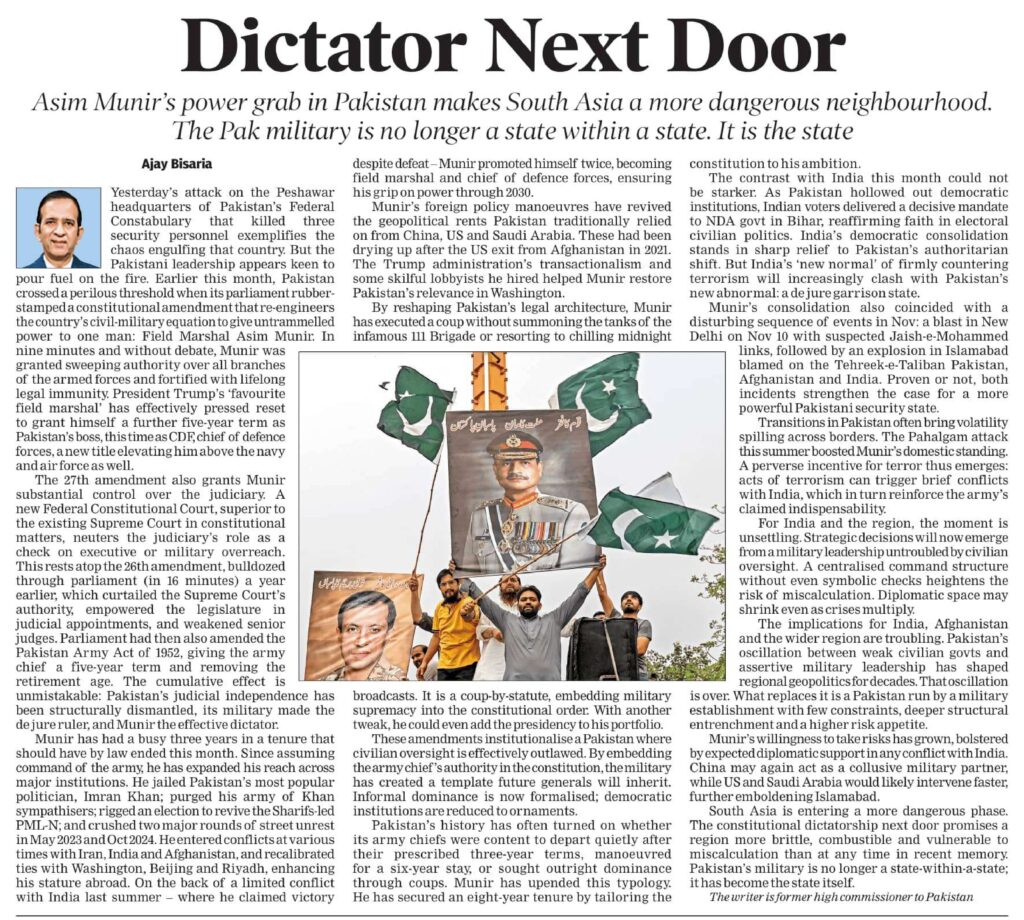
Asim Munir’s power grab in Pakistan makes South Asia a more dangerous neighbourhood. The Pak military is no longer a state within a state. It is the state Yesterday’s attack on the Peshawar headquarters of Pakistan’s Federal Constabulary that killed three security personnel exemplifies the chaos engulfing that country. But the Pakistani leadership appears keen […]
Book Chapter: A Decade of Steady Economic Decay
Authors – Ajay Bisaria, Abhishek Kumar Abstract This piece analyses Pakistan’s persistent economic challenges, particularly in the decade from 2013 to 2024. It links the country’s financial crises with structural weaknesses, primarily military dominance, that has led to political instability, flawed economic choices and an addiction to IMF bailouts. The economic crisis has aggravated from […]
Sindoor’s New Red Lines Are Drawn
When LeT terrorists struck in Kashmir on 22 April, Pakistan had effectively jumped on the first rung of a familiar conflict escalation ladder. It did so with implausible deniability of its role. But this time was different. The two countries climbed perilously higher into conflict than they had done ever before in this century. Between […]
CSC: Deterrence, Narratives, Acquisition Protocols, Adversaries and India’s Fight with Terror and Agents of Terrorism

CS Conversations convened an erudite panel of experts who know the business – diplomacy, global power tussles, military hardware and India’s positioning in our immediate neighbourhood. We bring you excerpts of this engaging, forward looking and critical conversation. The discussion was moderated by Maj General V K Singh and Navin Berry, Editor. Maj Gen VK […]
Munir’s Dangerous Doctrine
Ultimately, the Munir Doctrine is a dead end. It substitutes belligerence for strategic thinking. It indulges the military’s worst instincts. In trying to cast himself as heir to Jinnah and Zia, Munir is embalming a vision of Pakistan that no longer serves its people—and driving it toward becoming a reckless, war-making garrison state.
Sindoor’s New Red Line
Pakistan, by contrast, embraces external involvement. It needs the optics. It declares every Western phone call a validation of its global stature, just as it rebrands military defeats as victories. The Pakistani military’s propaganda wing, ISPR, will undoubtedly package Op Bunyan Ul Marsoos as an unqualified victory —short war, operational brilliance, and international attention.
The same logic was deployed to claim triumph in 1965, 1971, and 1999, each a setback to Pakistan’s army. What really matters is control of the domestic narrative.
As India celebrates Op Sindoor, a robust debate will take place on strategic choices and operational success. Across the border, Pakistan will project its army chief, General Asim Munir, as a victor. He will expect that this limited conflict has bolstered his authority. It plays into long-standing paranoia about India, casting the army as the nation’s sole saviour.
India has now made a doctrinal pivot in its fight against terrorism. India does not need war—or passive restraint. It has delivered a credible, coercive slap against terrorism. But will that prevent the next Pahalgam? Will it make Pakistan rethink the costs of using terrorism as strategy? For India, deterrence is not about spectacle. It has reshaped the adversary’s calculus.
Pulwama
On Valentine’s Day in February 2019, a convoy of buses carrying paramilitary personnel snaked its way from Jammu to Srinagar on National Highway 44. Just short of Lethapora, a little town in Pulwama district, a loud explosion drowned out the quiet hum of the cavalcade. It was 3.15 p.m. A bloodied Kashmir once again became […]