Dictator Next Door
Asim Munir’s power grab in Pakistan makes South Asia a more dangerous neighbourhood. The Pak military is no longer a state within a state. It is the state
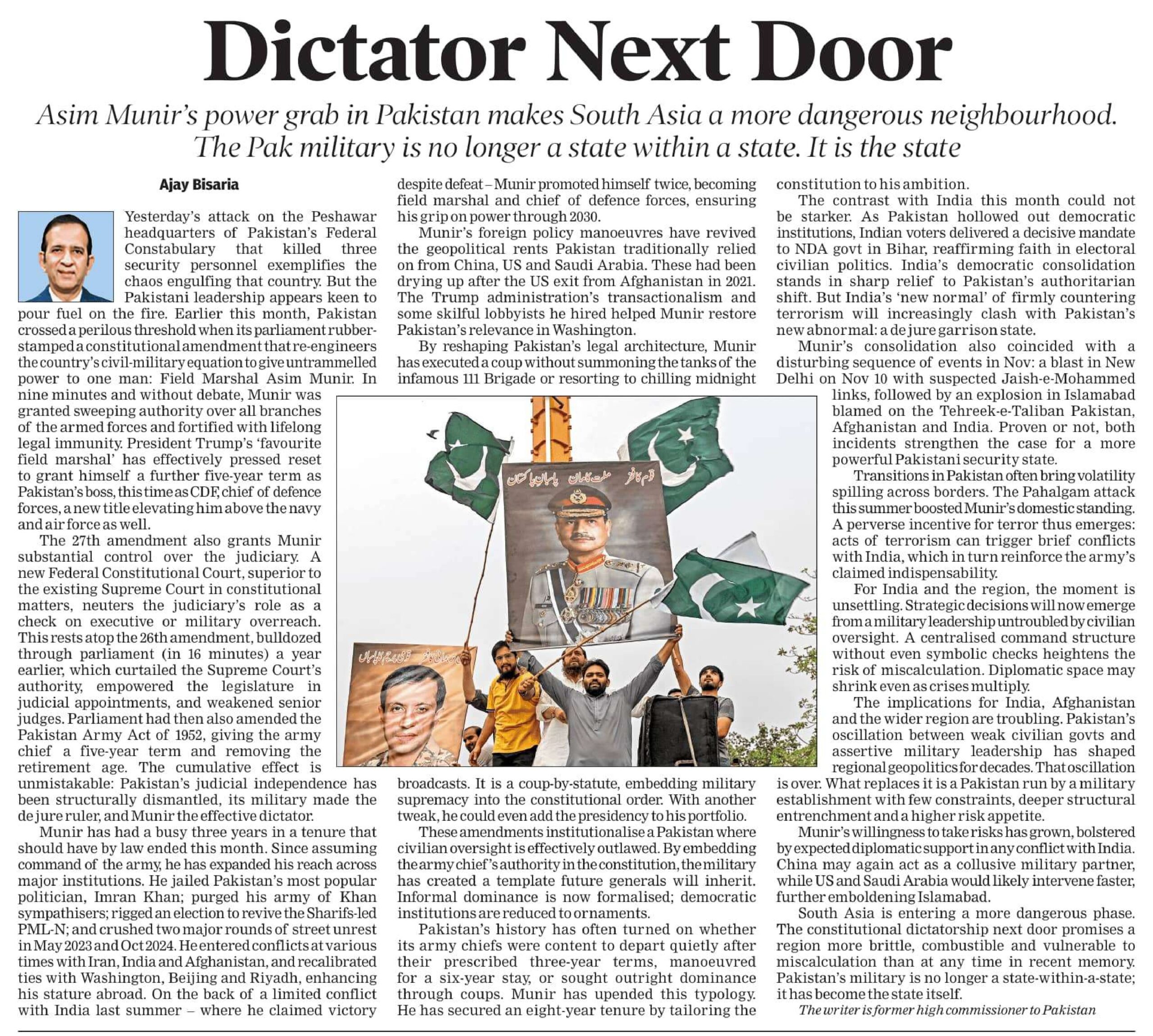
Yesterday’s attack on the Peshawar headquarters of Pakistan’s Federal Constabulary that killed three security personnel exemplifies the chaos engulfing that country. But the Pakistani leadership appears keen to pour fuel on the fire. Earlier this month, Pakistan crossed a perilous threshold when its parliament rubber-stamped a constitutional amendment that re-engineers the country’s civil-military equation to give untrammelled power to one man: Field Marshal Asim Munir. In nine minutes and without debate, Munir was granted sweeping authority over all branches of the armed forces and fortified with lifelong legal immunity. President Trump’s ‘favourite field marshal’ has effectively pressed reset to grant himself a further five-year term as Pakistan’s boss, this time as CDF: chief of defence forces, a new title elevating him above the navy and air force as well.
The 27th amendment also grants Munir substantial control over the judiciary. A new Federal Constitutional Court, superior to the existing Supreme Court in constitutional matters, neuters the judiciary’s role as a check on executive or military overreach. This repeats the 26th amendment, bulldozed through parliament (in 16 minutes) a year earlier, which curtailed the Supreme Court’s authority, empowered the legislature in judicial appointments, and weakened senior judges. Parliament has then also amended the Pakistan Army Act of 1952, giving the army chief a five-year term and removing the retirement age. The cumulative effect is unmistakable: Pakistan’s judicial independence has been structurally dismantled, its military made the de jure ruler, and Munir the effective dictator.
Munir has had a busy three years in a tenure that should have by law ended this month. He has commanded the army, he has expanded his reach across major institutions. He jailed Pakistan’s most popular politician, Imran Khan; purged his army of Khan sympathisers; rigged an election to revive the Sharif-led PML-N; and crushed two major rounds of street unrest in May 2023 and Oct 2024. He entered conflicts at various times with Iran, India and Afghanistan, and recalibrated ties with Washington, Beijing and Riyadh, enhancing his stature abroad. On the back of a limited conflict with India last summer where he claimed victory broadcasts. It is a coup-by-statute, embedding military supremacy into the constitutional order. With another tweak, he could even add the presidency to his portfolio.
These amendments institutionalise a Pakistan where civilian oversight is effectively outlawed. By embedding the army chief into the constitution, the military has created a template future generals will inherit. Informal dominance is now formalised; democratic institutions are reduced to ornaments..
Pakistan’s history has often turned on whether its army chiefs where content to depart quietly after their prescribed three-year terms, maneuverered for a six-year stay, or sought outright dominance through coups. Munir has upended this typology. He has secured an eight-year tenure by tailoring the constitution to his ambition. The contrast with India this month could not be starker. As Pakistan hollowed out democratic institutions, Indian voters delivered a decisive mandated to NDA govt in Bihar, reaffirming faith in electoral civilian politics. India’s democratic consolidation stands in sharp relief to Pakistan’s authoritarian shift. But India’s new normal of formally countering terrorism will increasingly class with Pakistan’s new abnormal: a de jure garrison state.
Munir’s consolidation also coincided with a disturbing sequence of events in Nov: a blast in New Delhi on Nov 10 with suspected Jaish-e-Mohammed links, followed by an explosion in Islamabad blamed on the Tehreek-e-Taliban Pakistan, Afghanistan and India. Proven or not, both incidents strengthen the case for a more powerful Pakistani security state.
Transitions in Pakistan often bring volatility spilling across borders. The Pahalgam attack this summer boosted Munir’s domestic standing.A perverse incentive for terror thus emerges: acts of terrorism can trigger brief conflicts with India, which in turn reinforce the army’s claimed indispensability.
For India and the region, the moment is unsettling. Strategic decisions will now emerge from a military leadership untroubled by civilian oversight. A centralised command structure without even symbolic checks heightens the risk of miscalculation. Diplomatic space may shrink even as crises multiply.
The implications for India, Afghanistan and the wider region are troubling. Pakistan’s oscillation between weak civilian govts and assertive military leadership has shaped regional geopolitics for decades. That oscillation is over. What replaces it is a Pakistan run by a military establishment with few constraints, deeper structural entrenchment and a higher risk appetite.
Munir’s willingness to take risks has grown, bolstered by expected diplomatic support in any conflict with India. China may again act as a collusive military partner, while US and Saudi Arabia would likely intervene faster, further emboldening Islamabad.
South Asia is entering a more dangerous phase. The constitutional dictatorship next door promise a region more brittle, combustible and Vulnerable to miscalculation than at any time in recent memory. Pakistan’s military is no longer a state within a state, it has become the state itself.
The Article was published in The Times of India.