Why Pak army must now feel the heat
India must re-impose deterrence and reinforce security A lush meadow in Pahalgam was soaked in innocent blood this week, marking the most painful terrorist blow to India since 2008. As investigators confirmed Pakistan’s role in the massacre, 22/4 became another grim reminder that its western neighbour remains India’s primary adversary. Strategic neglect is not an […]
India’s Multi-Vector Engagement: Can It Include Pakistan?
A major question that arises in this context is whether India can reach tactical understandings, if not strategic resets, with its traditional regional adversaries, China and Pakistan. Both rivalries, at the very least, consume considerable strategic bandwidth and military resources. In the case of the northern neighbour, despite Chinese incursions into the Galwan Valley in 2020 followed by a military stand-off on the Himalayan border, India and China have doggedly continued military and diplomatic conversations to de-escalate the crisis and reach a modus vivendi. This has led to the stirrings of a tactical adjustment, with a Modi – Xi meeting in 2024 and softening positions in 2025.
Book Review: Anger Management: The Troubled Diplomatic Relationship Between India and Pakistan
For Bisaria, the relationship between India and Pakistan has been stormy, rocky, and turbulent since their birth as the successor states of British India amidst the chaos of partition in 1947. In the introduction of the book, he argues that “anger” is the defining motif of the Indo-Pak dynamic, stemming from issues such as partition, territorial disputes, and terrorism, hence the name Anger Management. These issues are deeply entrenched and challenging to resolve, making the effective management of relationships essential to prevent further deterioration. Moreover, the book seeks to answer critical questions such as what do Indian diplomats do in Pakistan, and how do they manage a relationship that is fraught with more lows than highs and more pessimism than hope?
Book Excerpt: Essays in Mutual Comprehension
Manmohan Singh added poetically that this meeting was ‘an essay in mutual comprehension’ and that the two leaders would together write a new chapter in the history of the two countries. Musharraf presented Singh a painting of the school in Gah village (now in Pakistan), the Indian PM’s birthplace, and where he had had his initial schooling. On his part Singh again recited the Urdu couplets which he had read out to Musharraf in their phone conversation.
Thirteen Days of Liberation: The Birth of Bangladesh
Excerpt from Anger Management Chapter 10 “A Second Partition, Third Country” Part 1 Read here Excerpt from Anger Management Chapter 10 “A Second Partition, Third Country” Part 2 “On 6 December, the Indian government announced its formal recognition of the government of Bangladesh. On the battlefield, India had an overwhelming advantage. A limited West Pakistani […]
12/13 The Parliament Attack
That afternoon, a group of officers from the PM’s security, the SPG, came in to my office. They were convinced that the PM was the primary target of the assault and thanked me for my fortuitous morning intervention. Our obsession in the PMO on ‘no pendency’ had prevented the prime minister’s carcade from crossing paths with the terrorists. Five days later, Home Minister Advani would confirm that ‘the terrorist assault on the very bastion of our democracy was clearly aimed at wiping out the country’s top political leadership.’
The Ex Who Won’t Go Away
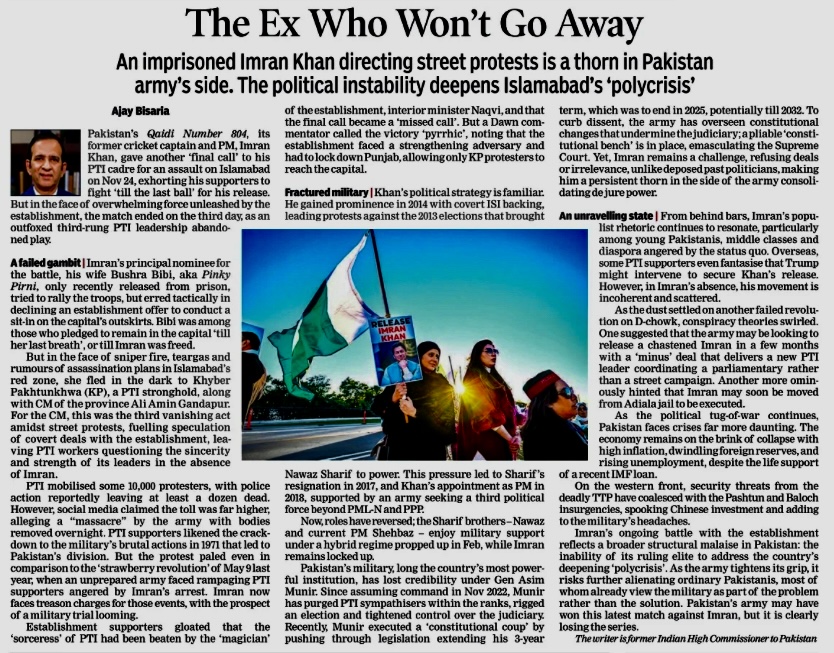
An imprisoned Imran Khan directing street protests is a thorn in Pakistan army’s side. The political instability deepens Islamabad’s ‘polycrisis’. Pakistan’s Qaidi Number 804, its former cricket captain and PM, Imran Khan, gave another ʻfinal callʼ to his PTI cadre for an assault on Islamabad on Nov 24, exhorting his supporters to ‘fight till the […]
The Print: Pakistan foreign minister was in Delhi on 26/11. India’s only ‘retribution’ was expelling him
With telling revelations, memoir, and account of history, Ajay Bisaria’s Anger Management is a study of the diplomatic engagement between India and Pakistan.
Book Excerpt: A Grab at Kashmir
The 1965 war was born of 1962, which left us looking like bumblers…. We foiled Pakistan’s resulting adventure, doubtless an achievement, albeit limited, but it turned Pakistan to other means: fomenting dissidence in our Punjab, feeding subversion elsewhere, developing terror as an instrument of policy, apart from making life difficult in J&K, while scheming its way to nuclear power. All comprehensively demonstrating an undying obsession—doing India down, wresting J&K.
Dealing with Pakistan: India’s Western Neighbour is No Longer a Strategic Priority
India’s Pakistan policy has evolved over the last decade, from an attempted rapprochement in 2014-15, to a focus on stringent border management and counterterrorism. Even though India’s primary strategic challenge over the next decade would emanate from the north i.e. China- the country’s most recalcitrant western neighbour will continue to pose a sub-conventional security threat.