2026: India’s Sweet Spot Year?
2025 was a testing year for India on the geopolitical front. Confronted with the Trumpian revolution that aggravated trade tensions, major power rivalries, secondary effects of wars and structural economic shifts, India needed to navigate turbulent waters with continuous tactical calibration. India did follow Minister Jaishankar’s 2020 mantra on major power play, albeit with a […]
In Conversation with Rajesh Mehta: Ambassador Ajay Bisaria
A seasoned diplomat with decades of experience across South Asia, Southeast Asia, and the Indo-Pacific, Ambassador Ajay Bisaria has been at the forefront of some of India’s most consequential diplomatic engagements. His insights reflect both strategic realism and a deep understanding of India’s long-term interests in a turbulent global order. He was the High Commissioner […]
Review: “Anger Management” by Ajay Bisaria – Former High Commissioner of India to Pakistan
The enduring hostility between India and Pakistan, initiated by the partition in 1947 followed by traumatic violence, and marked by four conventional wars, the bifurcation of Pakistan, proxy sub conventional wars in Kashmir and Punjab, nuclear tests, acts of terrorism, and surgical strikes, has become a seemingly permanent fixture in South Asian geopolitics. The relationship […]
Dictator Next Door
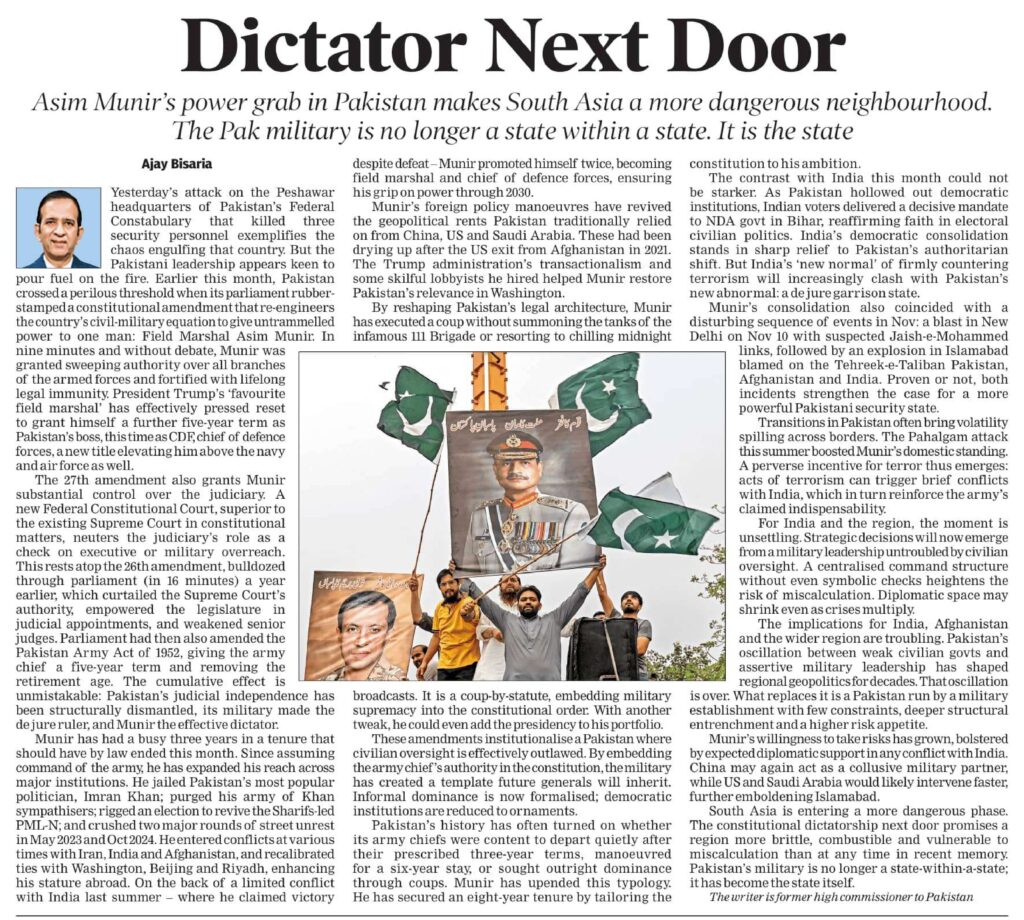
Asim Munir’s power grab in Pakistan makes South Asia a more dangerous neighbourhood. The Pak military is no longer a state within a state. It is the state Yesterday’s attack on the Peshawar headquarters of Pakistan’s Federal Constabulary that killed three security personnel exemplifies the chaos engulfing that country. But the Pakistani leadership appears keen […]
IBG NEWS: ICC Organises ICC Wealth Management Summit
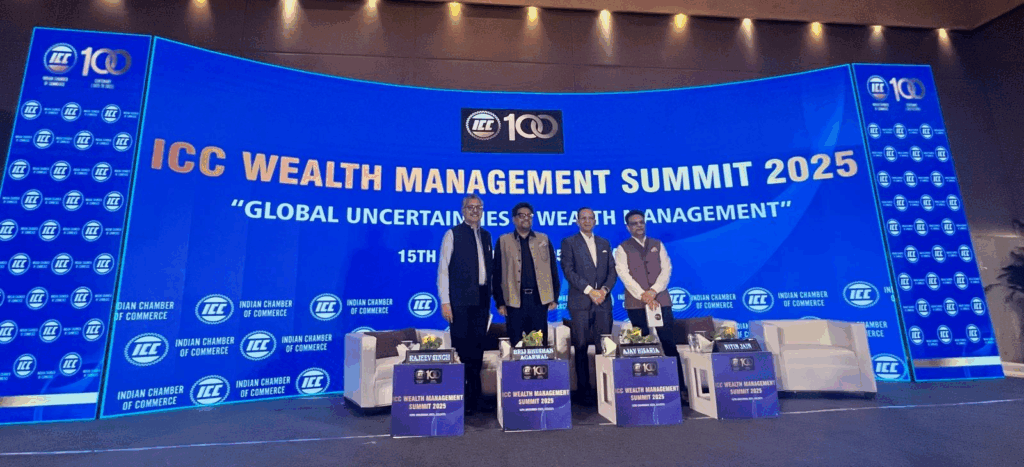
Kolkata, 15th November, 2025: ICC organised the ICC Wealth Management Summit 2025, bringing together industry leaders, policymakers and global advisors for wide-ranging discussions that spanned cutting-edge wealth management trends, India’s economic transformation, and the shifting geopolitical landscape. The summit was attended by Mr. Ajay Bisaria, Global Advisor to Asset Management Companies, author and former diplomat; […]
Business Today: Don’t be surprised if Trump shows up in Delhi’: Ex-Ambassador says US will stay India’s key partner
India’s primary strategic partner will remain the United States, Russia and the European Union will continue to be crucial partners, and China will remain a strategic competitor, says Ajay Bisaria Former Ambassador Ajay Bisaria has predicted that the United States will continue to be India’s key strategic partner despite recent tensions over Washington’s 50% tariff […]
Book Chapter:A Yogic Foreign Policy For a Fractured World
Blurb: To deal with the opportunities and challenges thrown up by a fractured world between orders, India’s foreign policy should be yogic: calm yet nimble and flexible. India must also shape the contours of the emerging order to its advantage.
Weathering the Trumpstorm: Navigating Tariffs in Indo-US Trade Relations
The road to peace in Europe—and fixing Indo-US relations—may pass through the icy corridors of Alaska If there is one tool that Donald Trump wields with as much relish as tariffs, it is sanctions. These are the blunt instruments of choice for America’s chief peacemaker and dealmaker, used both to halt wars and to remake […]
Sindoor’s New Red Lines Are Drawn
When LeT terrorists struck in Kashmir on 22 April, Pakistan had effectively jumped on the first rung of a familiar conflict escalation ladder. It did so with implausible deniability of its role. But this time was different. The two countries climbed perilously higher into conflict than they had done ever before in this century. Between […]
India’s Post-Conflict Diplomacy: Reclaiming the Global Narrative on Terrorism
The Pahalgam terrorist attack of April 2025 triggered the articulation of a new security doctrine by India—a ‘new normal’ for countering cross-border terrorism at its source, defining a revised national security and foreign policy vision. India’s robust military response—Operation Sindoor—was calibrated deterrence, designed to send a clear message of resolve, primarily to Pakistan but also […]