The Economist: India and Pakistan are bracing for a military clash
During the last big military stand-off between India and Pakistan, in 2019, Mike Pompeo was woken by an urgent call at his hotel in Hanoi. Mr Pompeo, who was then America’s secretary of state, described in a memoir being connected to an Indian minister who said Pakistan was preparing a nuclear strike on India. Mr Pompeo […]
BBC: India and Pakistan are in crisis again – here’s how they de-escalated in the past
Last week’s deadly militant attack in Pahalgam in Indian-administered Kashmir, which claimed 26 civilian lives, has reignited a grim sense of déjà vu for India’s security forces and diplomats. This is familiar ground. In 2016, after 19 Indian soldiers were killed in Uri, India launched “surgical strikes” across the Line of Control – the de facto […]
Why Pak army must now feel the heat
India must re-impose deterrence and reinforce security A lush meadow in Pahalgam was soaked in innocent blood this week, marking the most painful terrorist blow to India since 2008. As investigators confirmed Pakistan’s role in the massacre, 22/4 became another grim reminder that its western neighbour remains India’s primary adversary. Strategic neglect is not an […]
Carney’s Burden: Trump, Trade and A New World Order
With a mandate for economist Mark Carney in Monday’s Canadian elections, it is time to reset the damaged ties between Ottawa and New Delhi Among Donald Trump’s many unintended achievements during his first hundred days back in the Oval Office, one stands out north of the 49th parallel: he has given a leg up to […]
India’s Multi-Vector Engagement: Can It Include Pakistan?
A major question that arises in this context is whether India can reach tactical understandings, if not strategic resets, with its traditional regional adversaries, China and Pakistan. Both rivalries, at the very least, consume considerable strategic bandwidth and military resources. In the case of the northern neighbour, despite Chinese incursions into the Galwan Valley in 2020 followed by a military stand-off on the Himalayan border, India and China have doggedly continued military and diplomatic conversations to de-escalate the crisis and reach a modus vivendi. This has led to the stirrings of a tactical adjustment, with a Modi – Xi meeting in 2024 and softening positions in 2025.
Book Review: Anger Management: The Troubled Diplomatic Relationship Between India and Pakistan
For Bisaria, the relationship between India and Pakistan has been stormy, rocky, and turbulent since their birth as the successor states of British India amidst the chaos of partition in 1947. In the introduction of the book, he argues that “anger” is the defining motif of the Indo-Pak dynamic, stemming from issues such as partition, territorial disputes, and terrorism, hence the name Anger Management. These issues are deeply entrenched and challenging to resolve, making the effective management of relationships essential to prevent further deterioration. Moreover, the book seeks to answer critical questions such as what do Indian diplomats do in Pakistan, and how do they manage a relationship that is fraught with more lows than highs and more pessimism than hope?
ANI: India-Canada relations likely to improve post-Trudeau era: Former High Commissioner Ajay Bisaria
India-Canada relations likely to improve post-Trudeau era: Former High Commissioner Ajay Bisaria New Delhi [India], March 18 (ANI): Former High Commissioner of India to Canada Ajay Bisaria expressed optimism about the future of India-Canada relations, stating that a change in leadership in Canada could create an opportunity to mend diplomatic ties. He noted that the […]
Managing a Tough Neighbourhood
India’s neighbourhood policy demands strategic patience, embracing occasional anti-India regimes, navigating Chinese competition, and rejecting zero-sum approaches. A durable framework for regional security and prosperity should prioritize grants over loans, emphasizing economic and security cooperation, connectivity, and humanitarian assistance. Engagement spans energy collaboration, development aid, defence partnerships, disaster relief, cultural exchanges, and infrastructure projects. Encouraging Quad partners like the U.S., Japan, and Australia to join South Asia’s economic initiatives will enhance regional stability, despite occasional differences. Reviving SAARC will offer a more manageable mechanism for dialogue, complementing sub-regional platforms like BIMSTEC and BBIN, while reducing reliance on the China-led SCO.
Three Years of War in Ukraine
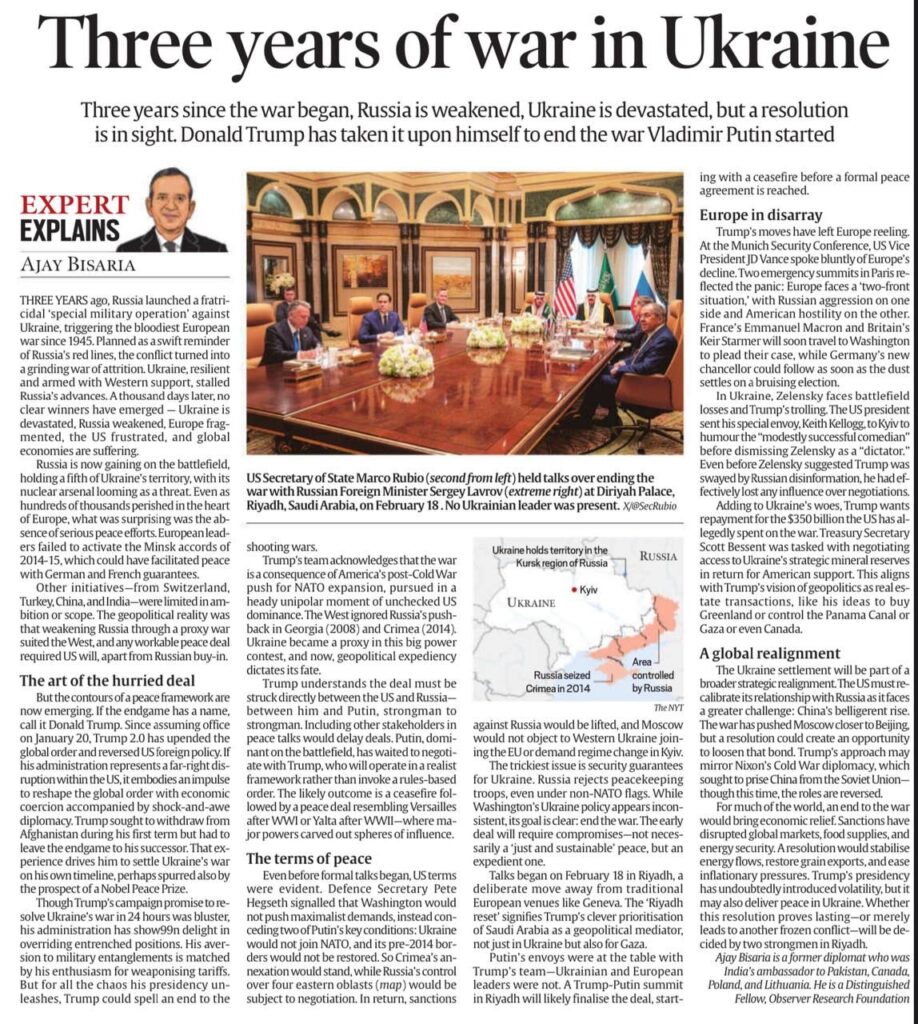
Trump understands the deal must be struck directly between the US and Russia—between him and Putin, strongman to strongman. Including other stakeholders in peace talks would delay deals. Putin, dominant on the battlefield, has waited to negotiate with Trump, who will operate in a realist framework rather than invoke a rules-based order. The likely outcome is a ceasefire followed by a peace deal resembling Versailles after WWI or Yalta after WWII—where major powers carved out spheres of influence.
Book Excerpt: Essays in Mutual Comprehension
Manmohan Singh added poetically that this meeting was ‘an essay in mutual comprehension’ and that the two leaders would together write a new chapter in the history of the two countries. Musharraf presented Singh a painting of the school in Gah village (now in Pakistan), the Indian PM’s birthplace, and where he had had his initial schooling. On his part Singh again recited the Urdu couplets which he had read out to Musharraf in their phone conversation.