Sprinkle Trade On Baked Alaska?
Trump-Putin’s summit could be a turning point for Ukraine and global commerce. If talks succeed, sanctions could be adjusted & India might face fewer tariff troubles. If talks fail, except a tougher Trump
If there is one tool Donald Trump wields with as much relish as tariffs, it is sanctions. These are the blunt instruments of choice for America’s chief peacemaker and dealmaker, used both to halt wars and to remake global trade in Washington’s image. India today finds itself at the receiving end of both weapons: locked in a trade war with the United States and staring at the possibility of 50% tariffs by August 27.
Yet, in the ‘Art of the Deal’ playbook, tariffs are only theatre. Trump starts with maximalist demands, pushes hard, and waits for the other side to blink. India has largely read this correctly. Across the world, Trump’s tariff targets have chosen between three strategies: retaliate, ignore, or negotiate. Patient negotiation has often yielded the best results. India saw the value of engagement early in the game. In February, Modi and Trump agreed to scale up bilateral trade from $200 billion to $500 billion by 2030, with a trade deal in place by 2025.
Five rounds of talks have already been completed. A near-final agreement sat ready for Trump’s signature until the US President pushed for last-minute concessions —greater market access for American soya, wheat, milk, auto parts and more.
When geopolitics intervened
Two developments complicated what was shaping up to be a largely economic negotiation: the flare-up in India-Pakistan tensions in May, and Russia’s refusal to budge on Ukraine.
Handling of the India-Pakistan crisis showed the limits of diplomatic finesse. India bristled at Trump claiming early credit for the Indo-Pak truce. Yet history offers examples of quiet American diplomacy in South Asia’s moments of peril — from Bill Clinton summoning Nawaz Sharif to Washington during the Kargil conflict, to Musharraf’s 2002 pledge under US pressure to curb cross-border terrorism, to Washington’s subtle nudges after Pulwama that, alongside India’s credible missile threat, helped secure the safe return of Wing Commander Abhinandan.
This nuance was drowned out in the contested domestic discourse on Operation Sindoor, where India’s military action rightly took centre stage but Washington’s behind-the-scenes role remained unmentioned. Trump, tone-deaf to Indian sensitivities, made matters worse by appearing to hyphenate India and Pakistan — even hosting Pakistan’s army chief for lunch. For India, it was as it would have been for Israel if, in the aftermath of October 7, the White House had rolled out the red carpet for a Hamas leader. Still, in retrospect, India could have avoided bruising Trump’s ego by acknowledging that US diplomacy had been helpful in amplifying India’s message to Pakistan.
Russia sanctions and collateral damage
The second irritant — secondary sanctions tied to Russia — was less about India and more about Trump’s frustration at Putin stringing him along on the Ukraine conflict. The fresh tariff announcement last Wednesday was, in essence, a prod to Moscow to take peace talks on Ukraine seriously. India was collateral damage.
Ironically, India had already signalled willingness to import more US energy if prices were competitive — which they increasingly were. But sanctions, especially when trumpeted with bluster, served Trump’s narrative of pushing Putin towards a settlement.
A shifting global chessboard
Geopolitics in August looks starkly different from July, even if the underlying strategic direction is the same. China has criticised US “bullying” of India. BRICS members are privately comparing notes on Washington’s heavy-handedness. And Modi is expected to meet Xi and Putin at an SCO summit later this month.
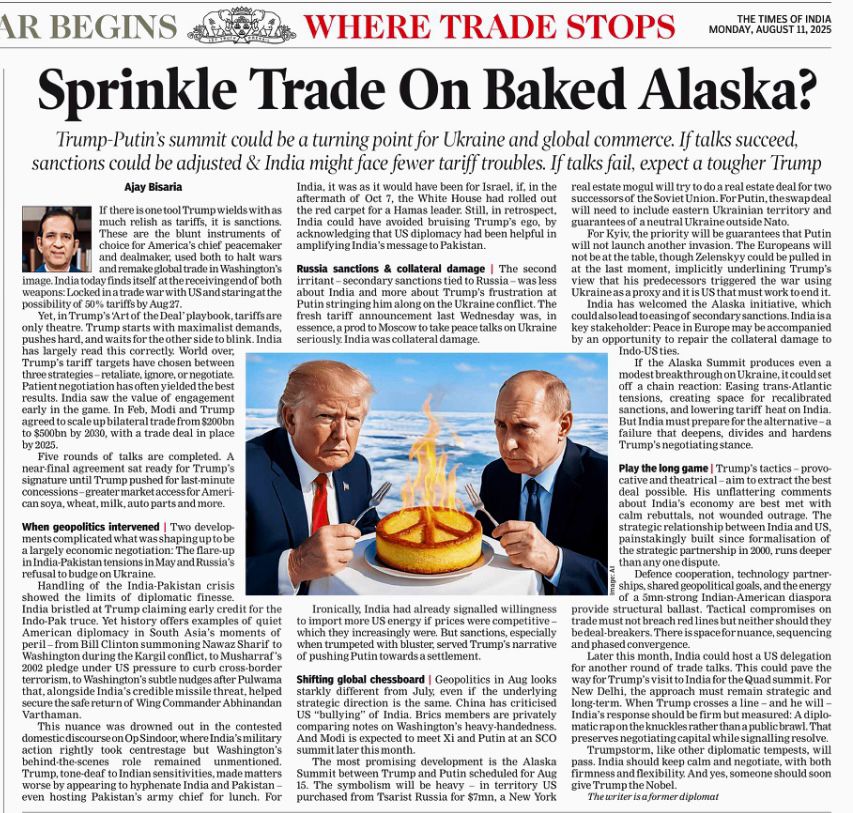
The most promising development is the Alaska Summit between Trump and Putin, scheduled for August 15. The symbolism will be heavy — in territory the US purchased from Tsarist Russia for $7 million, a New York real estate mogul will try to do a real estate deal for two successors of the Soviet Union. For Putin, the swap deal will need to include eastern Ukrainian territory and guarantees of a neutral Ukraine outside NATO. For Kyiv, the priority will be guarantees that Putin will not launch another invasion. The Europeans will not be at the table, (though Zelenskyy could be pulled in at the last moment) implicitly underlining Trump’s view that his predecessors triggered the war using Ukraine as a proxy and it is the US that must work to end it.
India has welcomed the Alaska initiative, which could also lead to the easing of secondary sanctions. India is a key stakeholder: peace in Europe may be accompanied by an opportunity to repair the collateral damage to Indo-US ties.
If the Alaska Summit produces even a modest breakthrough on Ukraine, it could set off a chain reaction: easing trans-Atlantic tensions, creating space for recalibrated sanctions, and lowering the tariff heat on India. But India must prepare for the alternative — a failure that deepens divides and hardens Trump’s negotiating stance.
Play the long game
Trump’s tactics — provocative and theatrical — aim to extract the best deal possible. His unflattering comments about India’s economy are best met with calm rebuttals, not wounded outrage. The strategic relationship between India and the US, painstakingly built since the formalisation of the strategic partnership in 2000, runs deeper than any one dispute.
Defence cooperation, technology partnerships, shared geopolitical goals, and the energy of a five-million-strong Indian American diaspora provide structural ballast. Tactical compromises on trade must not breach red lines but neither should they be deal-breakers. There is space for nuance, sequencing, and phased convergence.
Later this month, India could host a US delegation for another round of trade talks. This could pave the way for Trump’s visit to India for the Quad summit. For New Delhi, the approach must remain strategic and long-term. When Trump crosses a line — and he will — India’s response should be firm but measured: a diplomatic rap on the knuckles rather than a public brawl. That preserves negotiating capital while signalling resolve.
Trumpstorm, like other diplomatic tempests, will pass. India should keep calm and negotiate, with both firmness and flexibility. And yes, someone should soon give Trump the Nobel Prize!
xxx
The Article was first published in the print version of the Times of India on 11 August 2025.